Dear Fellow Parishioners of Our Lady of Divine Providence Family of Parishes,
Rejoice! Today, we celebrate “Gaudete” Sunday. Gaudete is the Latin word for “Rejoice”! It figured prominently in the traditional liturgy for this Sunday. In line with the theme of rejoicing, it is sometimes customary to wear lighter colored liturgical vestments and see more decoration of the altar, in anticipation of the coming light at the dawn of Christmas. We rejoice because we anticipate Jesus’ birth.
As we prepare for our celebration of Jesus’ birth, it is good for us to consider Mary, as she held Jesus in her womb, expectantly waiting for His birth with hope, and joy, and love beyond all telling. She was the original and living tabernacle, in which the Eucharist received her body and blood and made it His and ours. Please pray with these thoughts from St. John Paul II, in which he presents Mary, a living tabernacle, giving Jesus her body, and receiving the Eucharist, as a model for us:
In a certain sense Mary lived her Eucharistic faith even before the institution of the Eucharist, by the very fact that she offered her virginal womb for the Incarnation of God's Word. The Eucharist, while commemorating the passion and resurrection, is also in continuity with the incarnation. At the Annunciation Mary conceived the Son of God in the physical reality of his body and blood, thus anticipating within herself what to some degree happens sacramentally in every believer who receives, under the signs of bread and wine, the Lord's body and blood.
As a result, there is a profound analogy between the Fiat which Mary said in reply to the angel, and the Amen which every believer says when receiving the body of the Lord. Mary was asked to believe that the One whom she conceived “through the Holy Spirit” was “the Son of God” (Lk 1:30-35). In continuity with the Virgin's faith, in the Eucharistic mystery we are asked to believe that the same Jesus Christ, Son of God and Son of Mary, becomes present in his full humanity and divinity under the signs of bread and wine.
“Blessed is she who believed” (Lk 1:45). Mary also anticipated, in the mystery of the incarnation, the Church's Eucharistic faith. When, at the Visitation, she bore in her womb the Word made flesh, she became in some way a “tabernacle” – the first “tabernacle” in history – in which the Son of God, still invisible to our human gaze, allowed himself to be adored by Elizabeth, radiating his light as it were through the eyes and the voice of Mary. And is not the enraptured gaze of Mary as she contemplated the face of the newborn Christ and cradled him in her arms that unparalleled model of love which should inspire us every time we receive Eucharistic communion? …
What must Mary have felt as she heard from the mouth of Peter, John, James and the other Apostles the words spoken at the Last Supper: “This is my body which is given for you” (Lk 22:19)? The body given up for us and made present under sacramental signs was the same body which she had conceived in her womb! For Mary, receiving the Eucharist must have somehow meant welcoming once more into her womb that heart which had beat in unison with hers and reliving what she had experienced at the foot of the Cross. (Ecclesia de Eucharistia)
With great joy,
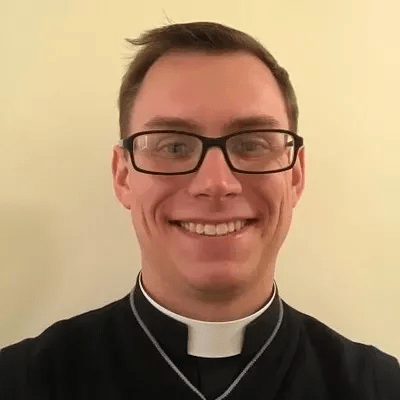
Fr. Henry Hoffmann