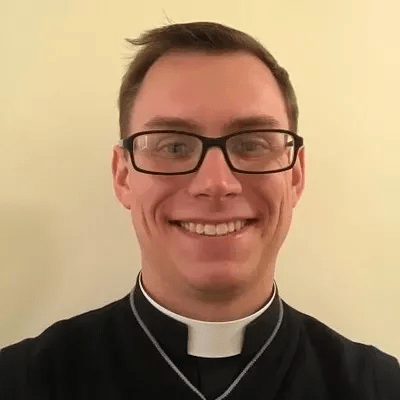
Dear Fellow Parishioners of Our Lady of Divine Providence Family of Parishes,
I write this after just completing my retreat and returning home. My retreat was a profound time of reflection and pondering in a beautiful wintry woods cabin. Thank you for your prayers, and know that I was praying for everyone here while away. I did a deep study of enthusiasm and vitality, which is something I want to personally foster more of in myself, and in our Family of Parishes. I look forward to sharing more insights over time, but for now, one of the key ideas I learned was that vitality grows when we embrace transitions generously. Like any family getting ready to welcome a child, Advent is a time of preparation and transition. We prepare our hearts to receive baby Jesus at Christmas, and prepare to receive Him again at His second coming. He also comes to us here and now in the Eucharist, and making the Eucharist a central part of our life is essential to our identity as Christians. And so in our Family of Parishes, we have seriously considered transitioning the Mass schedule to something more unifying, so that the Mass schedule can bring more people together at once.
While I was on retreat, the Worship Commission for the Family of Parishes met and proposed three possible new Mass schedules with their pros and cons. I faced the difficult choice of selecting one, and each of the options had their advantages and disadvantages. Ultimately I went with the one that fostered the most unity within with the Family of Parishes, and that eliminated the fewest Masses attended by the fewest people. Over the upcoming weeks, I am sure there will be many questions, and I will provide more details about the advantages of the schedule and why it was the one I selected.
The committee also strongly recommended implementing the new schedule a little later, on the first Sunday of Lent. That will give us time to prepare, to unite choirs, to coordinate minister schedules, and to celebrate endings, transitions, and new beginnings together.
Together, let us embrace each moment and every transition with generous love. As Mary welcomed Jesus into the world, we can welcome Him into our hearts. That leads to conversion, the best kind of transition. Please prayerfully consider these words from St. John Paul II about Mary and the Eucharist:
In a certain sense Mary lived her Eucharistic faith even before the institution of the Eucharist, by the very fact that she offered her virginal womb for the Incarnation of God's Word. The Eucharist, while commemorating the passion and resurrection, is also in continuity with the Incarnation… there is a profound analogy between the Fiat which Mary said in reply to the angel, and the Amen which every believer says when receiving the body of the Lord… In continuity with the Virgin's faith, in the Eucharistic mystery we are asked to believe that the same Jesus Christ, Son of God and Son of Mary, becomes present in his full humanity and divinity under the signs of bread and wine… The body given up for us and made present under sacramental signs was the same body which she had conceived in her womb! For Mary, receiving the Eucharist must have somehow meant welcoming once more into her womb that heart which had beat in unison with hers and reliving what she had experienced at the foot of the Cross. (Ecclesia de Eucharistia)
Yours in Christ, with Mary,
Fr. Henry Hoffmann